 Right here, meet Wuxia Guji 👋🏻.
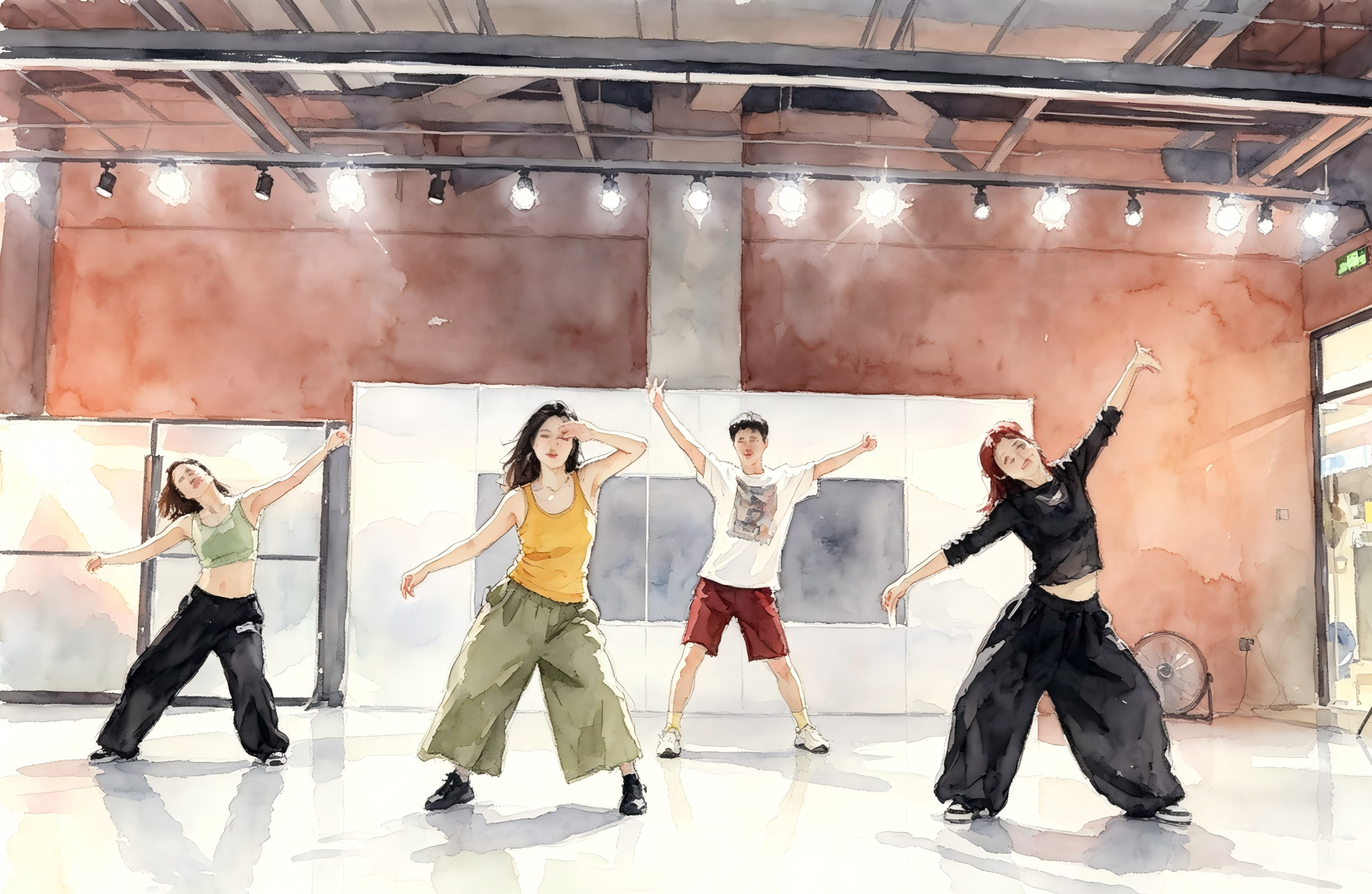
Thus, the article’s title was originally ‘I Hope They Still Dance After Giving Birth; I Hope Their Hair in Their 30s/40s/50s Is Still Blue, Purple, or Red’ (using feminine pronouns). When I thought of that well-built man in his 40s wearing a tank top and the dance studio owner John, I wanted to change ‘them (she/her)’ to ‘them (they/them and she/her)’.
In the studio, the Zumba classes are always the most joyful. Zumba sessions flow seamlessly from one happy tune to the next, each track accompanied by a few dance steps, entirely free from standardized, rigid movements.
I am one of the few young women in my 20s present; most of the other women are in their 30s and 40s, alongside one or two rare men.
I watch their expressive movements; they dance so uninhibitedly and boldly. I am deeply moved and infected by their energy—some possess graceful, slender figures, others are healthy and well-proportioned, with vibrant, multicolored hair. Even in their 40s, they still dye their hair purple or red.
You rarely see them in the classes taught by younger instructors. They don’t care to join those sessions because such classes are often overly disciplined, rigid, and broken down step by tedious step. Younger teachers simply lack the lived experience and depth required to hold and support the unhurried composure and bold vitality these individuals have gathered over time.
I love seeing them in their bold element. I love that their hair remains vibrant. I hope women return to the dance floor after giving birth. I hope that even when facing postpartum bodily changes, they remain confident and bright, stepping out of the house and into the studio. We will always welcome them.
The reason childbirth came to mind is that during Saturday’s class, a familiar figure caught my eye—a woman I hadn’t seen in the studio for a long time. She dances exceptionally well, with an uninhibited, vivid excellence that once earned her praise from Sea [the instructor mentioned in Writing Your Own ‘Personal User Manual’—Running, Climbing, Dancing] for her immense progress.
Let’s call her X for now. When X entered the classroom, Yuanxin, the instructor, remarked, “Long time no see! It feels like over a year since I last saw you.” X smiled bashfully and replied, “Yes, I went to have a baby.” Yuanxin, being a woman who has also experienced childbirth, offered her an encouraging look—a gaze filled with a quiet, supportive force and unspoken strength. She said, “Wow, that’s wonderful. It’s truly great to see you back in class now.” It was clear that X was not as confident as before; her posture post-childbirth lacked its prior form, and her movements were not as light or agile.
I suppose both of them knew that for a woman, reclaiming parts of herself after childbirth is no simple feat. First come the physiological alterations, followed by the psychological pulls of family and a newborn.
Yet, simply seeing X back in the studio provided me with an immense sense of strength. You see, a person’s sheer presence and showing up can be profoundly inspiring. This is exactly why so many prominent figures continue to project spiritual influence long after they have stepped away or passed on.
When I entered the room, Yuanxin noticed me. I was scanning the studio and hadn’t seen her approach until she said hello. Turning around, I blurted out, “Hello, teacher! You look so beautiful!” (And indeed, I meant it sincerely.) I genuinely dislike taking classes filled only with young girls, as there is often an underlying tension—an atmosphere of mutual scrutiny and evaluation.
In the corporate world, I frequently encounter deeply entrenched dogmas that people treat as absolute truths, such as: “Women naturally engage in constant comparison and friction, whereas men cooperate and coexist; therefore, a department cannot handle two female sales representatives.” Or, when putting me into a comparison with others, someone might say, “You dance better than that other girl.” I have absolutely no interest in participating in such comparisons. I merely do what I wish to do, and I refuse to expend my mental bandwidth on these trivialities.
Nature operates entirely differently. These toxic atmospheres are merely internalizations propagated by leaders steeped in corporate politics. You and I have no need to fight them or get entangled; we only need to observe them calmly. I strive for equality, mutual support, and a balanced perspective. Thus, when they suggested omitting another girl from a dance rehearsal, I paid no heed and invited her to join anyway. When they evaluate my dancing against another’s, I choose to ignore it; there is no need for comparison, as we each simply enjoy the present moment of the dance.
I have also received quiet encouragement from a peer slightly younger than me. She always catches my eye with supportive glances and smiles while I dance. She is from Thailand, studying at our university’s College of International Education. Her Chinese name is Jiaying. Though we attend the same university, we met in the dance studio, and at the end of this month, she will return to Thailand.
A few days ago, as class ended and I was putting on my shirt and gathering my phone to leave, she called out to me: “Were you at the subway station the other day?” I replied, “Yes, that was me! I noticed you too, you seemed in a rush. So, are you a student at this university?” She said, “Yes, but my Chinese isn’t very good.”
I asked, “So you are a foreigner? But you look Chinese, perhaps like someone from an ethnic minority.” [For convenience, we conversed in English from that point onward, translated here.]
When I asked which country she was from, she explained she was a regular undergraduate from Thailand and that this month marked her final weeks in China. I asked how long she had been dancing and whether she understood the instructor’s spoken cues. She admitted she couldn’t understand them at all, yet she dances beautifully. I noted that this might actually be a blessing, because not understanding allows one to focus entirely on the physical movements of the dance.
You see, human interaction flowed into the room the moment this Thai girl called out to me. The atmosphere shifted from a disconnected space of isolated individuals into a fluid, shared field of mutual connection.
In front of Jiaying, I am always the talkative one, asking questions and sharing anecdotes. When she dances, she projects a sharp, distant intensity; if she hadn’t taken the initiative to interact with me, I doubt I would have had the courage to approach her, haha. Taking the first step requires real courage—what if she hadn’t remembered me from the subway? What if I weren’t the type to sustain an interaction when given the chance? What if I couldn’t speak English? But things unfolded perfectly; even if my English had been lacking, I am certain we would have communicated through a mixture of Chinese, English, and expressive gestures.
Now, let’s return our gaze to those in their 30s, 40s, and 50s. I hope they still dance after giving birth; I hope their hair in their 30s/40s/50s is still blue, purple, or red.
Of course, a large portion of the studio consists of hesitant individuals in those age brackets. Perhaps they have just started, or perhaps they have danced for a long time but remain self-conscious, unsure of where to place their limbs and overly aware of others’ glances. But it matters not. What I want to say is: please continue to dance freely and wildly, until you no longer care whether your steps are standardized or elegant. Immerse yourself completely, and in doing so, you become yourself.
The other day, I ran into John, the studio owner, at the entrance. I hadn’t seen him in a while because he maintains a separate full-time profession. He asked how I was doing, how my dancing was progressing, and whether I was memorizing the steps. I ended up sharing a thorough account of my recent journey.
I told him, “As you can see, I’m in a great state right now. The low point has just passed. My attitude toward dancing now is simply to immerse myself happily and lose myself in it. When you reach that point of blissful oblivion, the exact steps lose their importance. If you look closely, though my dancing has improved, I’m still not technically superb. However, I believe one’s internal state is what truly matters.” John nodded in agreement. I continued, “John, look at many of the people in this studio. They may have danced here for a long time, yet their underlying state hasn’t shifted; they are exactly as they were at the very start. But realizing this requires a prolonged journey of self-exploration, deep self-scrutiny, and questioning. Only they can discover it for themselves, and that process is painful.”
As a man in his 40s, John replied, “You’re right! It truly is.”
John couldn’t find much to add, but he mentioned that whenever I visit Hangzhou, I should look him up. I said, “Sure, I’ll buy you a coffee.”
Speaking of men in their 40s, I noticed another male participant in the Zumba class, likely in his late 40s or early 50s. He dances alongside the women, wearing a tank top, his physique well-built. I believe his very presence in that room—standing clear-eyed, facing forward, and moving to the music as one of the only men present—provides a profound sense of strength. He gives a young woman like me a distinct perspective on how an older man can choose to live; he offers the women of his own generation a sense of shared companionship that directly faces age; and he acts as a powerful wake-up call to men of his generation who have settled into a tedious, uninspired existence.
Originally, my title focused solely on women.
But when I thought of this well-built man in his tank top and John, the studio owner, I wanted to change the focus to include both men and women, declaring: “I Hope They Still Dance After Giving Birth; I Hope Their Hair in Their 30s/40s/50s Is Still Blue, Purple, or Red.” Because I am not a feminist; I do not look merely at the plight of women. I look at all of life itself. I am a questioner, a scrutinizer, a contrarian, an insightful observer, and a fluid voyager of life itself.
🎙️ Find Me
- Podcast: 【Right here 就在此地】
- Email: rightheretc@163.com
让我们彼此触达
万物穿身而过,就在此处。如果你想知道更多,或者想和我聊聊任何想法,或者单纯打个招呼,欢迎通过以下方式触达。(点击下方可跳转)
- 微信公众号 /
- 播客 /
- 网站 /
- rightheretc@163.com