 Right here, meet Wuxia Guji 👋🏻.
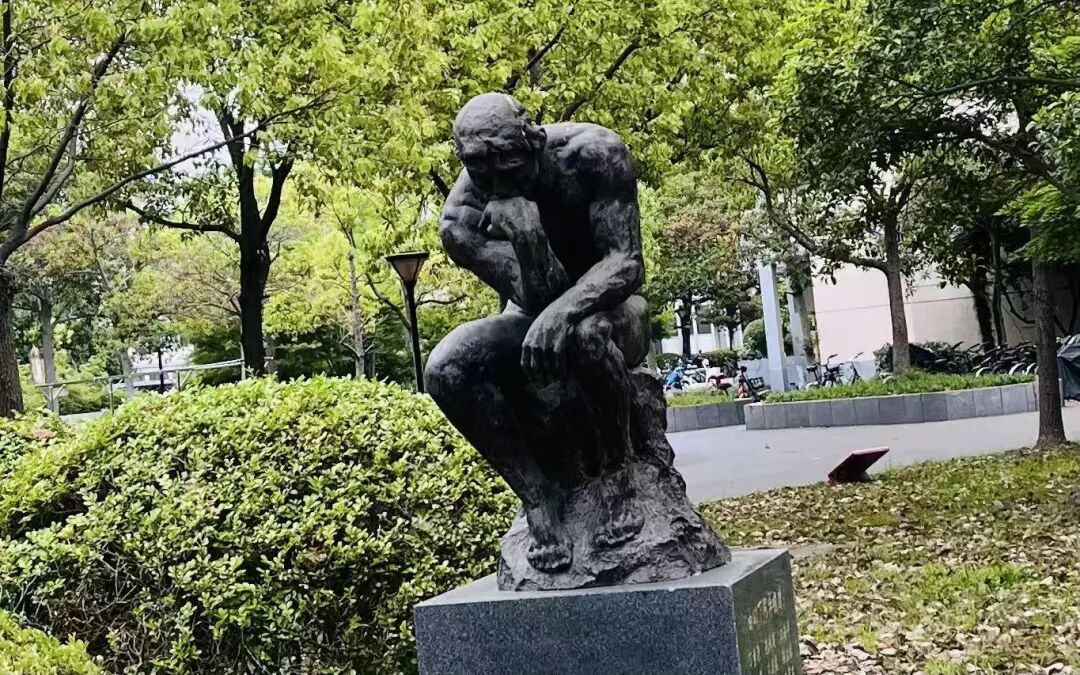
To observe oneself, describe oneself, and think about how one thinks—this is free will. Free will often happens when you cannot predict what you will think in the next second. This ‘unexpectedness’ is what we name free will.
‘Jumping Out Of the System’: The ultimate manifestation of free will. The moment free will happens is the very second you realize you are within the rules and decide to break them.
The self is a strange loop; flat logic cannot explain it—we need the missing puzzle piece of art. Art is more important than truth because pure truth will crush you. For instance: everyone dies, the world has no ultimate meaning, the universe does not care about you, and all order is accidental. If there is only logic, it seems to lead inevitably to nihilism.
So, what is art? It is looking into the abyss and still choosing to create, sing, dance, and love. Art turns life into a work of art. [Thus, we still laugh, dance, love, create, gossip, remaining both profound and lighthearted!!]
In his column Starry Sky Reading Club on April 12, Muyu Shuixin analyzed the book Gödel, Escher, Bach—commonly known as GEB. Why did he choose to decode this book? Perhaps because he was facing his own perplexities while reading it, or perhaps the state of this book perfectly aligns with his current state of being.
This triggered my own reflection: Why did Muyu Shuixin start explaining this book? (While others might focus merely on reading and interpreting the book itself). Here, my metacognitive ability comes into play. (What is metacognitive ability? It is the capacity to observe how you think, to step outside and observe yourself. This same way of thinking maps onto how others think and create, and the underlying reasons behind it. The next article will discuss the topic of metacognition in detail.)
I suppose this happens because I constantly self-examine and self-reference, which always makes me jump out of the system to look at problems. For example, when someone tells me something, I don’t focus on the event itself; instead, I look at why they chose to tell me this: What do they want to convey? What are their thoughts? What is their purpose? Doing this, however, is often energy-draining and isolating.
Muyu Shuixin is a creative content creator I deeply admire. His aura is calm, dense with knowledge, and warm—an attraction steeped in rational romance. When narrating, he always maintains an aesthetic distance. This is also why, even when budget constraints required him to appear on camera, he always wears a dark mask.
Let’s briefly explain what Gödel, Escher, Bach is primarily about.
Let’s focus our attention on the “ants” and “Aunt Hillary” mentioned in the book. A mole uses a stick on the ground to write the word “hello” to chat with Aunt Hillary, who is composed of countless ants. The nearby ants begin to gather on the word “hello” based on scent and sound, responding to the mole’s greeting. The mole then uses the stick to ask another question:
“Do you know you are made up of thousands of ants? Do you know you are composed of countless completely mindless ants?”
Aunt Hillary replies like this:
“Ants? What ants? I only know that I am having a delightful conversation with you.”
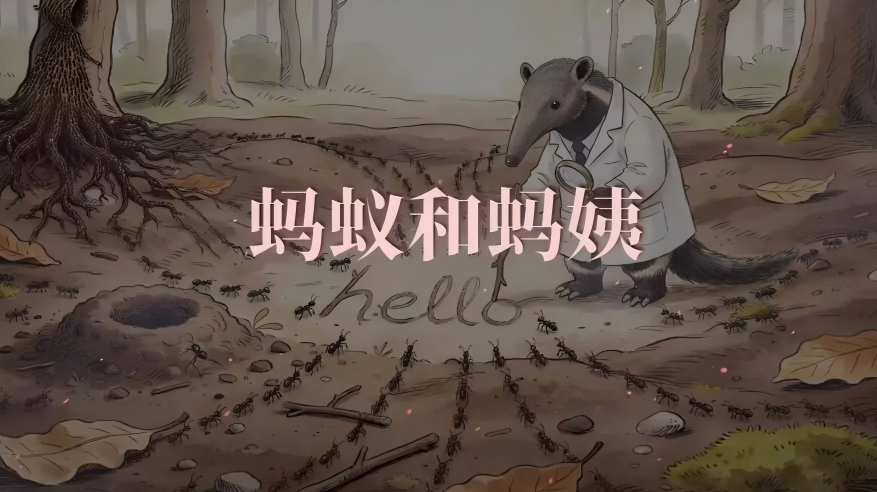
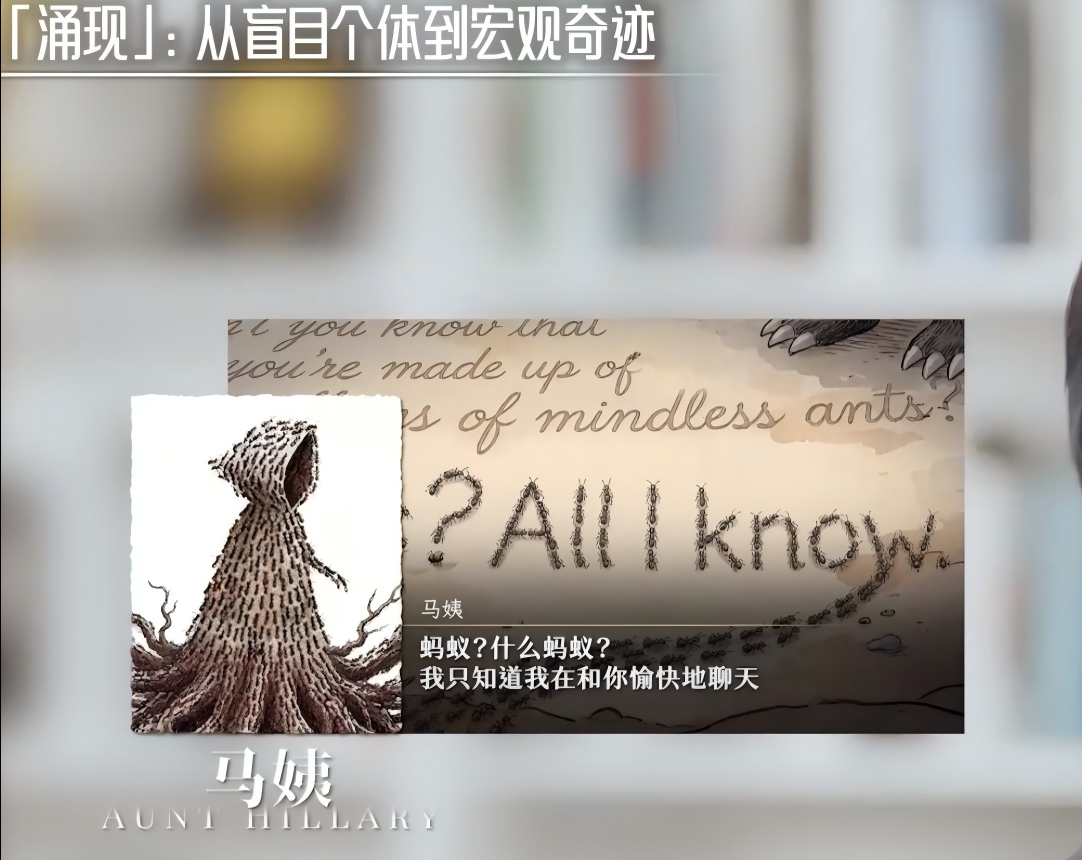
A fascinating answer. When you look at a single ant, you find it completely mindless; all its migratory movements are merely tracking pheromones, making local reactions, and following simple rules. However, when the massive movements and feedback of many ants overlap, “colony intelligence” emerges—which is Aunt Hillary in the picture.
Bach was invited to perform a musical movement at the royal palace. People strangely discovered that while the musical pitch was clearly climbing through the modulations, it ultimately and mysteriously returned to its starting point. This raises a question: “Why is it that while the local parts are constantly changing, the whole returns to itself?”
You see, when you attempt to self-reference, you fall into a blind spot and a strange loop. The core thesis of GEB is: The ‘self’ is a strange loop. Just like Bach’s pitch continuously rising only to return to its origin, or Aunt Hillary knowing nothing of ants and only knowing she is chatting happily with the mole.
Now we arrive at a highly intriguing point: Where does free will come from? What is self-consciousness? Free will originates from the closed loop of “self-reference.” When a system can observe itself, describe itself, and adjust its behavior based on that self-description, it generates the sensation of “I am in control.”
Amazing, everyone! Free will is woven out of the blind spots and strange loops generated by self-reference.
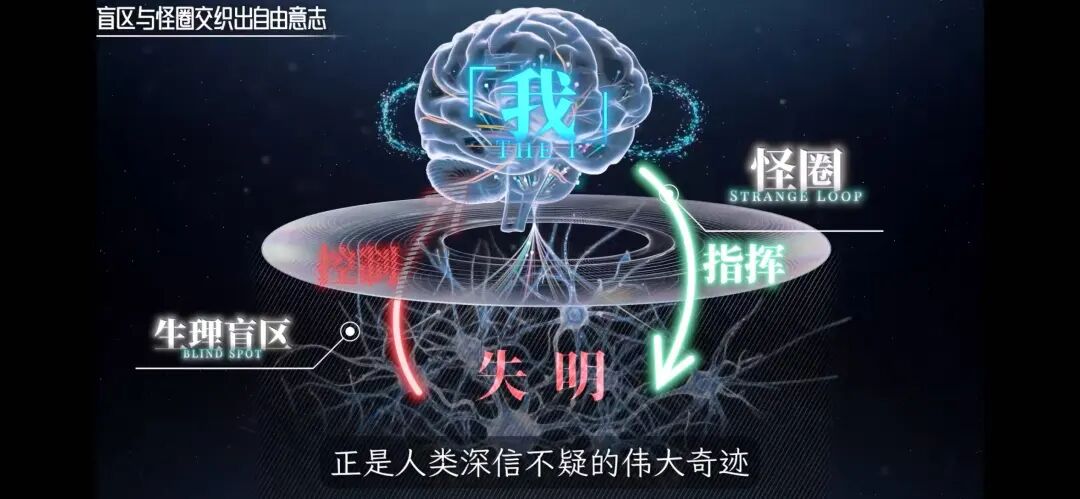
Free will often happens when you cannot predict what you will think in the next second. Because the underlying physical system of the brain is incredibly complex, we cannot perceive which neuron will fire next. The moment it occurs, a thought jumps out like a spark, and you have no idea how it emerged. This ‘unexpectedness’ is what we name free will. [So, seize your daily moments of sudden inspiration to your heart’s content!]
“Jumping Out Of the System”: The Ultimate Manifestation of Free Will
Although the underlying foundation is governed by physical laws, Douglas Hofstadter, the author of this book, believes humans possess a unique privilege: the ability to jump out of the system (JOOTSing, Jumping Out Of the System). The book notes that true intelligence lies in being able to recognize the boundaries of the system one is in and leap out of it. The stronger a system’s capacity for self-reference, the stronger its ability to leap out of itself, and the more “real” its free will becomes. He believes the moment free will happens is the very second you realize you are within the rules and decide to break them.
This book speaks of a crucial puzzle piece—art. Pure logic is flat; only art can make logic “curl up,” forming a self-referential sense of life. It is precisely because the brain cannot thoroughly see through itself that it leaves a space for “beauty” to occur. If everything were laid bare, life would become an instruction manual rather than art.
Art is more important than truth because pure truth will crush you. For instance: everyone dies, the world has no ultimate meaning, the universe does not care about you, and all order is accidental. If there is only logic, it seems to lead inevitably to nihilism.
So, what is art? It is looking into the abyss and still choosing to create, sing, dance, and love. Art turns life into a work of art. [Thus, we still laugh, dance, love, create, gossip, remaining both profound and lighthearted!!] Hence, we see why so many things ultimately culminate in art.
Martin Heidegger:
“Art discloses being; poetry is closer to truth than concepts.”
Carl Jung:
“Art is a vital outlet for subconscious self-regulation and symbol generation.”
Susan Sontag:
Against “over-interpretation,” arguing that modern people turn experience into interpretation, thereby losing their sensory capacity.
Hermann Hesse:
Constantly wrote about the process of “rational men ultimately returning to music, poetry, and flowing life.”
Albert Camus:
Emphasized creation, drama, art, and rebellion amidst the absurd.
Well, especially in the present day, when civilization is saturated with efficiency, KPIs, optimization, algorithms, traffic, and AI generation, art is actually preserving the “complexity of the soul” on behalf of humanity.
Anyway, getting sidetracked—let’s return to Muyu Shuixin.
-
A creator deeply rooted in humanities content choosing to interpret GEB at this time is usually not a random choice, but an inevitable return. Muyu Shuixin has spent years deconstructing movies and literature, which is essentially dealing with “perception and narrative.” But after analyzing hundreds of stories, one often encounters a meta-question: Why can these fictional symbols make humans generate genuine resonance?
-
Muyu Shuixin’s current state of creation itself possesses distinct “self-referential” characteristics. On one hand, he is explaining works; on the other hand, he has become a “benchmark” in the explanation industry. He must examine his own explanatory style, and this “examining one’s own examination” is a quintessential self-referential strange loop.
-
The Conflict Between Commercialism and Spirituality Among current content creators, short, fast media is everywhere. Maintaining a style that is “warm,” “detached,” “aesthetic,” and “profoundly analytical” requires a powerful underlying logic. He reads this book perhaps to confirm that within a system full of noise, searching for an undefinable “truth” is logical, even if it is unprovable.
Consequently, I often hear voices around me: Why don’t you make short videos? Why don’t you do live streams? Why don’t you commercialize rapidly? Why are you still writing texts, and doing all the writing entirely by yourself? Well, as I’ve said before, when I am writing, this state of continuous immersion in flow, and the state of expanding my own thinking, already fulfills my purpose. My purpose is largely completed during the creative process. If some articles can trigger significant traffic and prompt many people to share deep slices of their lives in the comments section, fostering certain connections or creating an infinite game where everyone participates, I find that beautiful.
Furthermore, writing is more vital than ever in the present era. It settles you down, enables you to think, and gives you another form of being outside of daily life—be it a profound dissection or a slight detachment. Moreover, the deep connection and resonance triggered by written text are often far more profound than what video can offer, and it is something AI-generated text can never achieve.
Naturally, alongside the texts updated on the official account and website, the audio podcast format will continue to exist. I always remember the podcast; I have never abandoned it, please rest assured.
🎙️ Find Me
- Podcast: 【Right here 就在此地】
- Email: rightheretc@163.com
让我们彼此触达
万物穿身而过,就在此处。如果你想知道更多,或者想和我聊聊任何想法,或者单纯打个招呼,欢迎通过以下方式触达。(点击下方可跳转)
- 微信公众号 /
- 播客 /
- 网站 /
- rightheretc@163.com