 Hi everyone, I am Wuxia Guji (无暇顾及). Welcome here to play.
My advice is: don’t follow anyone. Yes, that includes my account. So if you want to unfollow, just go ahead. Of course, I know you won’t listen to my advice, so it’s just a suggestion.
When I hear others say, “My advice is…” I usually respond: “You’d better not. Just let me hit the ‘southern wall’ (撞南墙) and see for myself.” For instance, someone asked me, “What’s the positioning of your account? You shouldn’t start without one.” I said, “There is no positioning. My style is having no style; everything is just me.” (Though from the outside, a distinct style inevitably forms.)
Why do I suggest not following anyone for long? It’s simple: people are narrow-minded. A person’s perspective is limited by their own experiences and environment. Many things are not universal or applicable. So, you’d better forge everything for yourself. Don’t listen to one person today and think it’s great, then listen to another tomorrow and think that’s great too—only to realize with alarm that they mean the exact opposite.
As your environment and state of mind change, many bloggers you used to like might now feel indifferent or even noisy. You both change; just accept it calmly. My followers fluctuate—some leave, new ones arrive—but the overall trend is upward. I think this is normal.
So, the best way is to read books that have survived the wash of history and watch movies. That’s part of Intake. The most important thing is to learn Output.
Watching my text is Intake; writing yourself is Output. Watching short videos is Intake; producing them yourself is Output. I encourage everyone to write, to have their own platform. Just write, and be happy and immersed while doing it.
But short videos are different from text. Short videos often involve too much performance and embellishment. Text, however, is calm—always quietly by your side, ready whenever you are. It forces you to organize your own system. And if you’re going to write, write long-form. Write the kind of long-form that requires repeated reading to fully understand, the kind where you need to extract the key points yourself. Write heart-felt long-form that draws the reader into deep immersion and thinking with you. (Doing the opposite of this era of ‘short-video snippets’ is why I’m also considering starting a long-form video podcast.)
Q: Where should we write? A: Anywhere / On any convenient device.
There should be no obstacles. When an idea comes, pick up your pen (or phone) and write. It doesn’t have to be a computer—you have to lug that thing around and find a place to open it. But a phone? You carry it every day. You can write while using the restroom, while walking, while on the subway…
I love holding my phone on the subway when inspiration strikes. Before I started writing, I felt the commute was too long and boring. I’d scroll aimlessly through Xiaohongshu until I felt dizzy—I seem to have some sort of ‘information overload intolerance syndrome.’ Since I started writing on the subway, I look forward to the commute every day, and it feels like I’ve reached my station in the blink of an eye.
Q: What to write? A: Write about anything you feel is worth writing.
If you have a feeling or a thought, write it down. Of course, you need to consider where it will be published and follow platform regulations to avoid being banned.
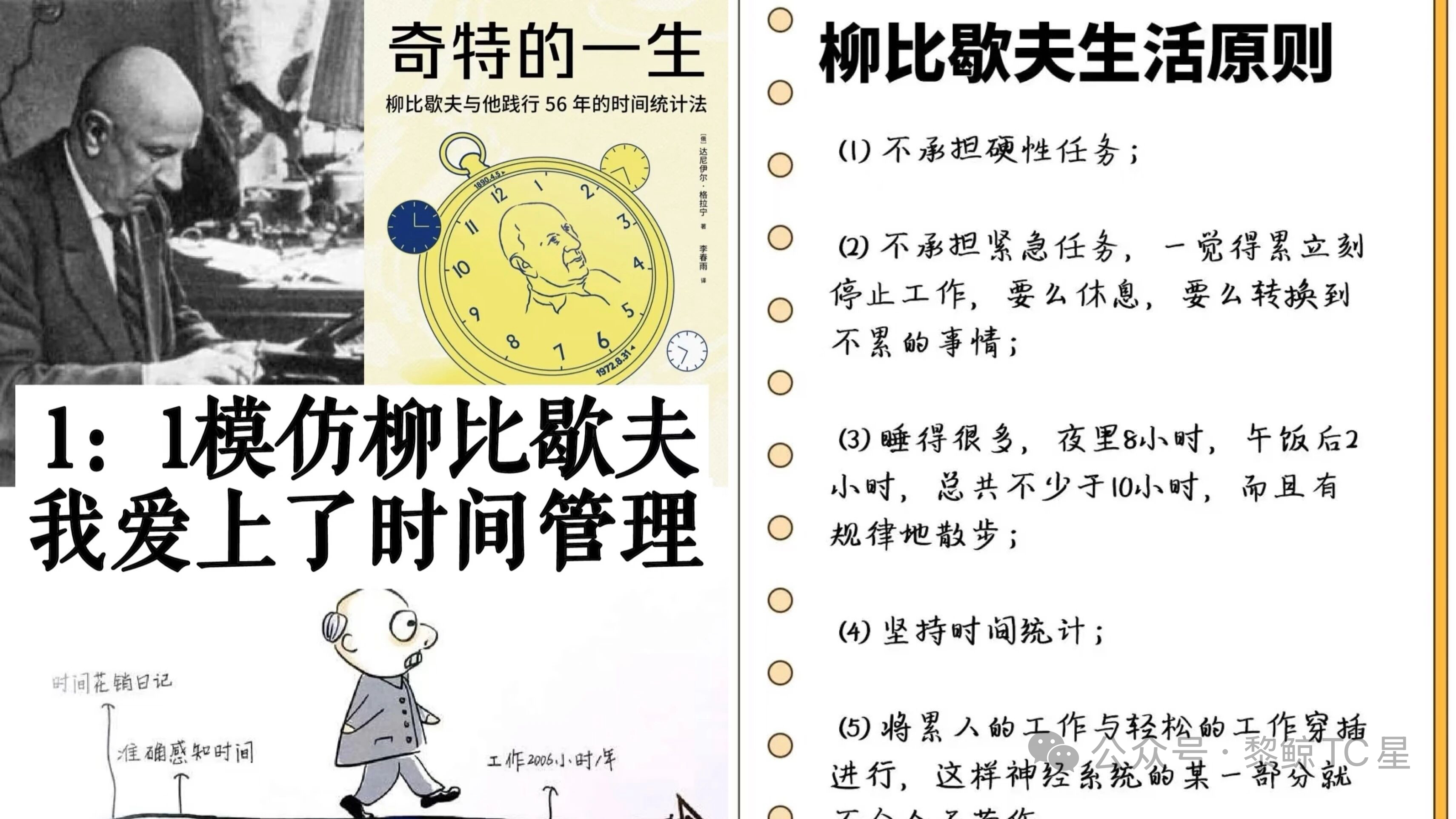
Classify after writing, not before. Classifying first adds too many restrictions. The Singular Life of Daniil Lyubishchev describes a unique time-management method. He didn’t plan first; instead, he recorded his time every day, accurate to the minute, and then summarized. He had a grand vision (like classifying all insects) and adjusted his daily time allocation based on his monthly/yearly progress.
This is a great method for P-types (Perceivers). Plans are a mystery to us; even if we make one, we won’t follow it the next day. But we have great flexibility—we can adjust anytime and go with the flow.
I’ve been recording my time daily for nearly 400 days now. So, get moving, everyone!
Q: Can daily reading really improve writing skills?
Well, it’s like cooking. It looks easy until you try it yourself and end up in a mess. So you’d better just start writing, regardless of tools or location, supplemented by reading. Cook a dish yourself, watch how others do it, and then form your own style.
That’s all for today. Let’s chat next time!
让我们彼此触达
万物穿身而过,就在此处。如果你想知道更多,或者想和我聊聊任何想法,或者单纯打个招呼,欢迎通过以下方式触达。(点击下方可跳转)
- 微信公众号 /
- 播客 /
- 网站 /
- rightheretc@163.com